The Corporate Future of Family Businesses: Generational Transition, Spin-offs, and Financial Restructuring
Family-owned businesses are the primary drivers of economic growth, employment, and innovation both in Turkey and on a global scale. While family-owned businesses account for approximately 80% of all businesses worldwide, this figure exceeds 90% in Turkey. However, this strong structure is quite fragile when faced with the challenges brought about by the passage of time and generational changes.
Data from PwC, TAİDER, and global research organizations indicate that family businesses face a serious "generational gap" This demonstrates that for a family business to evolve into a corporate legacy, it depends on proper planning for generational succession, the use of strategic division mechanisms when necessary, and the restructuring of its financial structure in line with contemporary requirements.
Generational Shift: The Third-Generation Syndrome and Statistics
In family-owned businesses, the biggest crisis begins when the founder steps down from management (or upon their death). The traditional saying, “The first generation builds it, the second generation grows it, and the third generation ruins it,” is, unfortunately, supported by statistics.
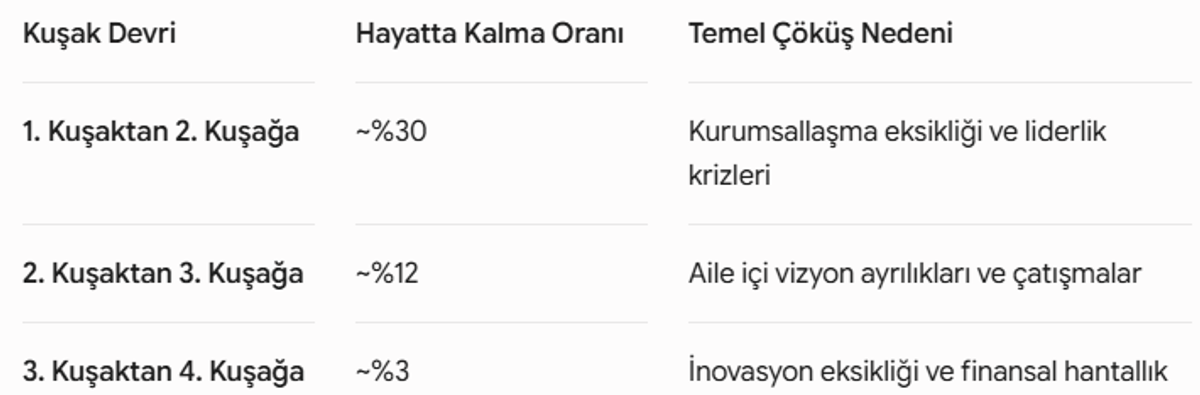
The main reason for this sharp decline is, "family logic" with "business logic" The conflict lies between these two perspectives. While family logic is based on equality, emotional bonds, and protection, business logic requires merit, competition, and profitability. For a successful generational transition, it is not enough to simply select an “heir”; it is also necessary to establish a framework that defines the limits of authority, shareholder rights, and the roles of professional managers. Family Constitution It is essential to create it.
From Conflict to Growth: "Split" as a Corporate Solution
As the business transitions to the second or third generation, differences in vision among siblings or cousins are inevitable. While one group may wish to focus on real estate investments, another group may prefer to prioritize industrial production. At this point, rather than liquidating or selling the company, the options provided under the Turkish Commercial Code (TTK) and the Corporate Tax Law (KVK) Split (Partial or Full Split) These mechanisms are lifesaving.
A strategic spin-off does not mean the company is shrinking; on the contrary, it means growing through greater focus:
- Tax-Free Restructuring: Divides carried out in accordance with the provisions of the Corporate Tax Law allow for the separation of assets without incurring heavy tax burdens such as corporate income tax, VAT, and real estate transfer tax.
- Risk Isolation: By separating high-risk investments from profitable operations into different legal entities, the company’s core operations are protected from financial crises.
- Peace Within the Family: Allowing family members with differing visions to part ways on a legal and fair basis safeguards the brand’s reputation and ensures the continuity of its business operations.
Financial Restructuring and Securing the Future
Generational transitions or spin-off processes must be supported by a thorough financial review and restructuring. For family-owned businesses experiencing growing pains or struggling under the weight of past debt, financial engineering is a necessity.
The basic financial steps to secure your future are as follows:
- Financial Statement Transparency and Independent Auditing: To gain the trust of the younger generation and foreign investors, the company must transition to financial reporting systems that comply with international standards (KGK/IFRS).
- Optimization of Investment Incentives: Instead of depleting equity capital for new investments, government support, regional incentives, and tax breaks should be utilized to the fullest extent possible.
- Legal and Financial Safeguards: For companies experiencing cash flow problems but with high commercial potential, offering a basis for reaching an agreement with creditors concordat Legal safeguards such as these should be viewed as a proactive restructuring tool that keeps the company afloat rather than leading to bankruptcy.
- Alternative Financing: Instead of relying solely on bank loans, a shift should be made toward institutional financing models such as private equity partnerships or initial public offerings (BIST).
Conclusion: Investing in the Future
In family-owned businesses, “sustainability” is not just an environmental concept; it is a financial and managerial necessity. Carrying the legacy left by the founding generation into the future is possible only when emotional decisions are replaced by data-driven strategies, and conflicts are resolved through corporate structuring aligned with tax planning and high-level financial advisory services.